Watts vs Heart Rate: Match Cycling Metrics to Your Goals
By Marta Kowalska • 23rd Nov
When selecting cycling metrics comparison tools for your training regimen, understanding how effective cycling performance metrics actually translate to your specific goals is paramount. As someone who's spent years diagnosing bike systems down to the torque spec of every fastener, I've seen countless riders choose metrics based on what's easiest rather than what's most effective for their objectives. Let me help you methodically match your cycling metrics to your actual training goals (whether you're chasing podium finishes or just quieter weekend rides that don't disrupt household harmony).
Understanding What Each Metric Actually Measures
Before diving into which metric serves you best, let's establish what we're actually measuring. Understanding the fundamental physics behind these numbers is critical for evidence-based training decisions. If you're new to training data, start with our exercise bike metrics explained.
Power (Watts) represents the actual work output being produced at the pedals. One watt is always one watt (a 200W effort today equals a 200W effort tomorrow). This consistency makes power metrics for cycling exceptionally valuable for precise training zones. Unlike other metrics that fluctuate with external factors, watts provide a direct measurement of your mechanical output.
Heart Rate (bpm) reflects your physiological response to the work being done. This metric is inherently delayed and influenced by numerous variables including:
- Hydration status
- Sleep quality
- Temperature and humidity
- Recent training load
- Stress levels
- Even your morning coffee
As a professional who's diagnosed countless bike systems, I appreciate that power's immediate responsiveness makes it the tool-specific metric for interval training where precision matters. When you stand up to sprint, power responds instantly while heart rate lags behind (sometimes by several minutes). If your monitor's lag or spikes seem off, use our heart rate calibration checklist to verify accuracy.
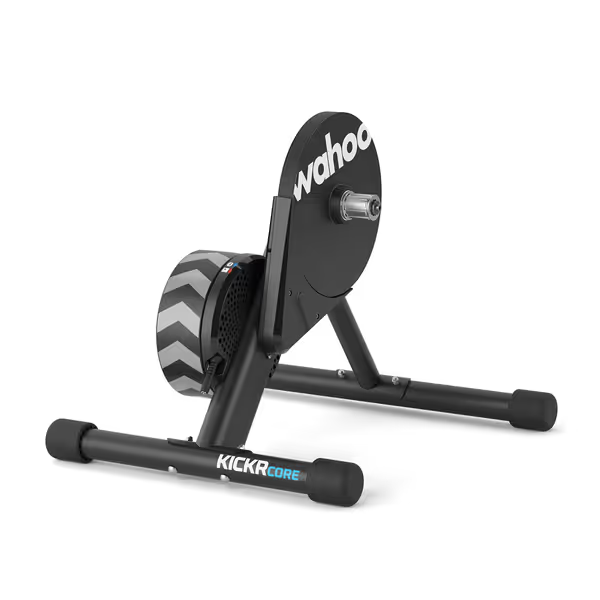
Wahoo Fitness KICKR CORE 1
Quiet, durable smart trainer for realistic indoor cycling with any app.
$349.99
Flywheel Weight12 lbs
Flywheel Weight12 lbs
Pros
Ultra-quiet operation, ideal for shared spaces.
Robust build and smooth, realistic ride feel.
Open-ecosystem: use with any popular training app.
Cons
Cassette not included, requires separate purchase.
Customers find the bicycle trainer works like a charm and is very easy to set up, with one mentioning it takes just a few minutes to attach the legs. Moreover, the product receives positive feedback for its solid build quality, smooth operation, and quiet performance.
Customers find the bicycle trainer works like a charm and is very easy to set up, with one mentioning it takes just a few minutes to attach the legs. Moreover, the product receives positive feedback for its solid build quality, smooth operation, and quiet performance.
Strengths and Limitations: Beyond the Marketing Hype
Let's break down the practical realities of each metric through a safety-first lens:
Power Metrics: The Precision Tool
Pros:
- Immediate feedback (no cardiac drift)
- Consistent day-to-day (no variation from fatigue or hydration)
- Directly tied to performance outcomes
- Enables precise zone training
Cons:
- Requires investment in quality equipment
- Doesn't directly reflect physiological strain
- Needs periodic calibration to maintain accuracy
The watts vs heart rate cycling debate often misses a critical point: power metrics demand proper maintenance. I've found that poorly calibrated power meters (especially those built into smart bikes with proprietary systems) can drift by 5 to 10% over time, enough to throw off your entire training plan. Regular checks against a known standard are essential for evidence-based training.
Heart Rate: The Physiological Indicator
Pros:
- Readily available (most fitness trackers include it)
- Reflects total body stress
- Excellent for long-duration recovery rides
- Cost-effective alternative to power meters
Cons:
- Suffers from cardiac drift (HR rises while power output stays constant)
- Influenced by external factors
- Slow response time
- Limited accuracy for interval training
For those seeking RPM for fat burning, heart rate offers a rough proxy through zone-based training. However, its perceived exertion accuracy diminishes significantly during variable efforts, precisely when you need the most reliable data.
Matching Metrics to Your Specific Training Goals
Let's methodically work through which metric serves which goal best. This decision tree approach mirrors how I'd diagnose a bike system, starting with the objective and working backward to the appropriate tools.
Goal: Short-Term Performance Gains (Races <4 Hours)
Recommended metric: Power
For shorter, high-intensity efforts where every watt counts, power provides the immediate feedback necessary to maintain precise effort levels. When your friend's smart bike arrived buzzing uncontrollably (a story that cemented my repair-first philosophy), we diagnosed it using power metrics to isolate the exact components causing resistance fluctuations. The same precision applies to your training, power metrics let you hit exact wattage targets without relying on physiological signals that might not align with your immediate performance needs.
Goal: Long-Duration Endurance (Races >4 Hours)
Recommended metric: Combined power and heart rate
Here's where evidence-based analysis shines. While power tells you what you're producing, heart rate reveals how your body is responding. I've found that observing cardiac drift (when heart rate rises while maintaining steady power) provides crucial insight into hydration, fatigue, and overall endurance capacity. This dual-metric approach helps cyclists avoid blowing up mid-ride when physiological strain exceeds what the power numbers alone would suggest.
Goal: General Fitness and Weight Management
Recommended metric: Heart rate with perceived exertion
For non-competitive riders focused on health outcomes, heart rate provides sufficient guidance for RPM for fat burning zones. However, I always recommend pairing it with perceived exertion (a 1 to 10 scale of how hard the effort feels). This dual approach accommodates day-to-day variations in your body's response while still keeping you in effective training zones.
Practical Implementation: Setting Up Your System Right
Now that you know which metrics serve your goals, let's methodically implement them:
- Establish your baseline: perform a 20-minute time trial to determine your functional threshold power (FTP), or use a max HR test if power isn't available
- Create your zones: calculate your specific training zones based on your baseline numbers
- Set your device parameters: configure your cycling computer or app to display the relevant metrics for your current workout
- Schedule regular verification: power meters need calibration checks; heart rate monitors benefit from periodic max HR retests
Standard fasteners save futures, this principle applies to data standards too. Choose devices with open protocols (ANT+ or BLE-FTMS) that work across platforms rather than proprietary systems that lock you into single ecosystems. See which bikes truly support open data in our fitness API compatibility comparison.
Advanced Strategy: Combining Metrics for Optimal Insight
As you advance in your cycling journey, consider using both metrics together for what professional coaches call "dual metric training." To build aerobic efficiency without overreaching, follow our Zone 2 training guide. This approach leverages the immediate feedback of power with the physiological context of heart rate.
How to implement dual metric training:
- During steady-state efforts: Maintain target power while monitoring heart rate drift
- For recovery rides: Keep heart rate in zone 1-2 while ignoring power
- For interval training: Focus on hitting power targets first, then note how heart rate responds
I've used this combined approach to diagnose everything from minor drivetrain inefficiencies to serious overtraining issues in athletes. When wattage drops while heart rate stays elevated, it often signals fatigue or mechanical issues, just like when a bike's power output drops while the motor strains harder.
Making Your Choice: Practical Considerations for Real Riders
While purists argue endlessly about which metric is "best," the pragmatic reality is that your choice depends on your specific circumstances:
Choose power if:
- You're training for competitive events
- You want precise interval control
- You have access to reliable, well-maintained equipment
- Your bike system has accurate power metrics
Choose heart rate if:
- You're primarily riding for health and fitness
- You're on a budget
- You're training for ultra-endurance events where physiological strain matters more than precise wattage
- You're dealing with equipment that has questionable power calibration
Remember that even the most sophisticated metrics are useless without proper maintenance. For riders who need lab-tested accuracy, consider our verified power accuracy picks. I've seen countless riders trust faulty power readings because they didn't realize their belt tension was off-spec or their sensor needed recalibration. A methodical maintenance routine beats the fanciest metrics every time.
Final Insight: Fix First, Then Decide if Upgrade Money is Deserved
Before investing in new equipment, take inventory of what you already have. Many modern smart bikes and trainers offer both metrics (often buried in settings menus). Check your device's calibration procedures and ensure it's functioning within specification before assuming you need more expensive gear.
Your cycling journey isn't about chasing the latest metrics, it's about understanding what truly moves the needle for your specific goals. Whether you're measuring watts or heart rate, consistency in measurement and methodology matters far more than which metric you choose.
Fix first, then decide if upgrade money is deserved.
Further Exploration:
- Calculate your personal power-to-heart-rate relationship by recording both metrics during a structured workout
- Try a "no metrics" ride to reconnect with perceived exertion
- Investigate how your specific indoor bike's power sensor can be calibrated for better accuracy
- Explore the reliability of your current equipment before committing to new purchases
By approaching cycling metrics comparison with methodical precision rather than marketing hype, you'll develop a training approach that delivers real results, without unnecessary complexity or cost. After all, the most effective cycling metric is the one you understand and use consistently toward your personal goals.
Related Articles